


Yang Shenshen, assistant professor at Tianjin University, gave an academic report in the School of Insurance and Economics
Yang Shenshen, assistant professor at Tianjin University, gave an academic report in the School of Insurance and Economics
On May 4, 2023, at the invitation of the School of Insurance and Economics, University of International Business and Economics, Yang Shenshen, assistant professor of Ma Yinchu School of Economics, Tianjin University, shared an academic report entitled “Sharp Bounds on Treatment Effects for Policy Evaluation” in Room 509, Boxue Building. The subject of this report is the problem of parameter estimation in the process of policy evaluation. The report meeting was chaired by Yu Chan from the Department of Labor Economics and Social Security. Teachers and students of the School of Insurance and Economics participated in the meeting online or offline.
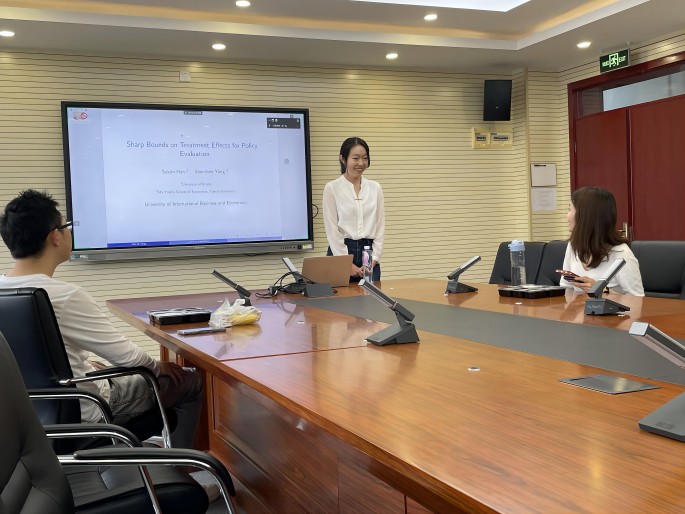
Teacher Yang Shenshen first pointed out that for counterfactual policy evaluation research, it is very important to ensure the correlation between parameters and policies. But this may be a challenge when there is unobserved heterogeneity. This problem is well represented in the definition of the local average treatment effect (LATE) since this parameter is local in nature and only reflects the average treatment effect (ATE) in a specific population (i.e., “adherents”). These facts lead to two major challenges in choosing LATE as a reliable parameter for counterfactual policy evaluation: first, the subgroup used to measure the effect may not be the population in which the policy interest lies; second, the definition of the subgroup depends on the chosen instrumental variable, making the parameters more difficult to generalize in new environments.
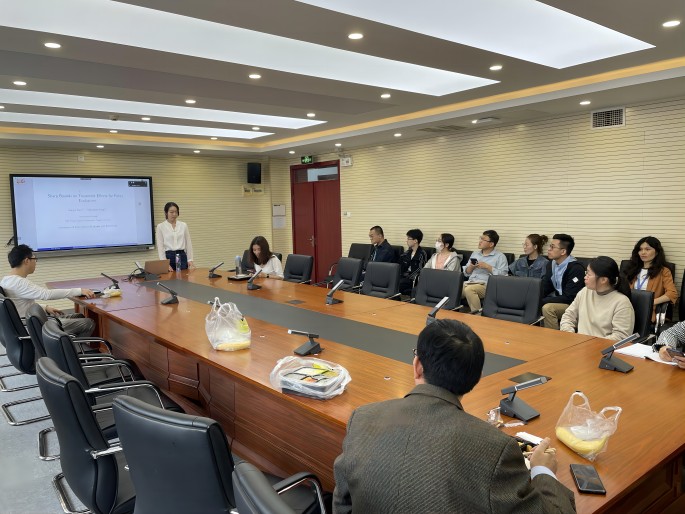
Subsequently, Professor Yang showed how to use binary instrumental variables and systematically calculate various generalized sharp non-parametric boundaries of processing parameters based on binary and continuous dependent variables. These parameters were defined as weighted averages of MTE, specifically including ATE, the treatment effect on processors, the LATE of subgroups induced by the new policy, policy-related treatment effects (PRTE), etc. Professor Yang also explained how to introduce broader identification assumption constraints, generalized the research results of early literature, and demonstrated the effectiveness of the method in this paper by taking the impact of medical insurance policies on the use of medical services as an example.
Yang Shenshen’s research results have important implications for improving the accuracy of parameter estimation in policy evaluation. During the report by Professor Yang, teachers and students present had an in-depth discussion with Professor Yang and benefited a lot.